Wednesday, May 20, 2020

The spherical 5-bar linkage

I've been working on one, and amused to find that the physical construction and control software took about the same amount of time. Here's a movie, under control of the mouse in the other hand:


The idea of a spherical linkage is that all the motion takes place on the surface of an imaginary sphere, but in reality the links can be at different radii as long as their motion is well-described by rigid shapes moving on the sphere.  That makes it possible to construct in the real world.
There's some fairly cute math involved in converting a position you want the end axis to be, to angles to set the driving servos.  Quaternions are involved.

Thursday, April 30, 2020

20-20 Nanometer Hindsight

It's always a good idea to ask people like me, who claim to be futurists, just how well their predictions are coming along. Even more so those of us who go so far as to say things like, "Here's what we could have and should have done, but didn't," as I did in Where is My Flying Car.

So here we are in the midst of a global pandemic, which everybody is talking about and loudly opining every which way about what we should have done, but didn't, but which most of the opiners didn't actually say anything about beforehand.

Was I any better? I think so. For example, the main thrust of the book was that we should have flying cars, as part of a geographically-distributed, non-crowded, high-energy, public-transport-free lifestyle. Much has been made recently of the fact that many of the green-inspired virtue-signaling fads ranging from crowded subways to reusable grocery bags are quite counterproductive, and amusingly have flipped from being mandatory one day to prohibited the next.

Personal flying cars are clearly a better choice than cattle-car airliners.

Here's a slightly less obvious consequence of what could have been, given we had avoided our disastrous ergophobic funk and continued to follow the Henry Adams Curve: my house, like many buildings nowadays, gets climate control from a heat pump, which in the winter is a bit more efficient that simply dumping energy into the air by simple resistance heater. But in order to get as much efficiency as possible, the system works by recycling the air, rather than continually pumping fresh air into the house. So things that people breathe out, such as CO2, build up, as I can measure using a CO2 meter.

Well, it turns out that people breathe out SARS-Cov-2 as well. That doesn't matter so much in my house, but bigger buildings where lots of people meet, ranging from restaurants to schools, and there's a lot of air being breathed at second, third, and so forth hand that didn't have to be except for ergophobia.
So yes, we should have stayed on the Henry Adams Curve and we would have been somewhat less susceptible to the rapid spread of the Wuhan coronavirus.

But the one thing I particularly identified in the book which would have made a huge difference, which is blindingly glaringly obvious and on which I spent several chapters in the book: We should have developed nanotechnology.

You want an RNA sequencer in a grain of sand? Nanotech. You want a completely reliable test that you just pin to your lapel and it runs constantly (by sampling your breath)? Nanotech. You want that manufactured in 300 million quantity in two days? Nanotech. You want a mask that samples the air that you breathe in and out, but destroys (as well as counts) every coronavirus going either way? Nanotech. You want a nanomachine that mounts guard on every ACE2 receptor on your bronchial epithelial cells, destroying any virus that tries to breach them? Nanotech.
You want toilet paper by the ton? Well, do you?

Monday, April 6, 2020

A possible SARS-Cov-2 proxy

Let us presume that you wish to prevent contracting, or spreading, this virus. Obviously you should avoid those behsviors and environments most conducive to the spread. Unfortunately, our benighted experts know so little about how that works that we are forced to avoid all contact whatsoever.
What we would like is a pair of VR glasses that simply showed us the virus, in the air or on surfaces, wherever it happened to be. We don't have that. Is there a next best thing?

How it spreads

Basically we don't know. In the absence of knowledge, health experts are assuming it spreads the same way as a cold or flu. Chances are it does; but the coronavirus spreads a lot faster and further than those. 
The first thing about it is that it has a long asymptomatic incubation period, during which some of which the patient is infectious. In fact, from the statistics I've seen, something like half of those infected never show symptoms at all. So there are a lot more people walking around thinking they're fine, but actually spreading the virus.
But it's likely that's not the whole story.  People catch it from those they never touch and who never sneeze. It probably has other vectors than a normal cold. 

Choir practice


I believe the case of the Skagit Valley Chorale is instructive. After a practice session March 10, about half the choir came down with Covid-19. And yet:
In light of the coronavirus outbreak, Comstock said they greeted each singer with hand sanitizer at the door, they were individually spaced out during rehearsal, each singer used their own sheet music, and they avoided shaking hands or hugging.
Furthermore,
 “During the entire rehearsal, no one sneezed, no one coughed, no one there appeared to be sick in any way,” she said.
What did happen? Two and a half hours of singing. That's a lot of deep breathing of shared air. The infection rate among the Skagit Valley singers was extremely high, probably twice as high as on the Diamond Princess cruise ship where the passengers were cooped up together for over a month.

Bad Air

The only reasonable inference seems to be that the aerosol theory, which holds that the virus spreads not so much from visible droplets from a cough but microscopic ones perhaps containing just one virus, might be the major vector. 
The virus itself is about 0.12 μ, has a Reynolds number in air of 3e-8 and a settling velocity of 3e-4 cm/s. That's 0.0000067 mph. With any air circulation it will remain in the air indefinitely. So when people keep breathing the air in a closed space, it will build up and build up. 
We have to start thinking of the virus as a gas. My guess is that it's the elevated concentration of SARS-Cov-2 virus that led to the high infection rates. 
So what we need, to determine the danger level of a given environment, is a gas detector that measures SARS-Cov-2 virus concentration. But we don't have one.
What we do have, however, is a proxy. People also exhale CO2. And we do have CO2 detectors. 
So let me propose that a CO2 detector can be used as a worst-case measure for  SARS-Cov-2 concentration in the air. Worst-case because of course there may be many people breathing who are not spreading the virus. But if you're outside and the CO2 level is about 400 ppm, you're probably safe. If you're inside and it's 2500, open windows or turn on that attic fan. 
In other words, yes, a ventilator can save your life. But it's not necessarily the kind of ventilator people have been talking about.


Saturday, November 30, 2019

An electric car economy

Recently, Brad Templeton posted a column at Forbes examining whether an electric car economy could handle peak-travel holiday loads. The major problem, of course, is that electrics have limited range at a time when, in Perry Como's words, "From Atlantic to Pacific, the traffic is terrific." So everybody is on the road and needing a recharge at the same time. In holiday traffic, you often wait in line at the pump to fill up, but with gas, that's not too much time; with a half-hour recharge, it's completely impractical.
Brad thinks it would be possible with a major build-out of recharging facilities (and it would also require a major upgrade of power generation and transmission lines). But what if that is looking at the problem backwards? What if we could reuse the current infrastructure, and do electric cars the way we do gas ones? The problem vanishes, and we could gain quite a few extra advantages.
So in the current system, you go to the service station and put 50 pounds of gasoline into the car, taking a few minutes since it has to flow in through a smallish hose. In an average car, that will get you 250 miles or so before you need to fill up again, and you'll need a rest stop long before then anyway. Why not simply have removable batteries, and pop new ones in instead of letting the car sit while you recharge the old ones? That's the way most high-powered hand tools work today, for example.
EGO system power tool batteries
There's one major problem with this for a car. The battery in a Tesla weighs 1200 pounds and when fully charged, can power it about 300 miles. You won't be "popping in" one of those.
How big a battery could you pop in? The average man can handle 50 pounds (what typical lead-acid car batteries weigh) for the few seconds it would take to take it off a service cart and onto a connector mount like the one on a power tool easily enough, and for other people a service station attendant could do it. But 50 pounds of Tesla battery would only take you 12 miles.
But those are not close to the best batteries we have. Instead of 4 pounds per mile, a lithium metal battery holds enough energy to go one mile per pound. Popping in 5 of them would get you 250 miles of range and take less time than filling with gas.
The problem, of course, is that the lithium metal battery -- it's the chemistry used in watch batteries, for example -- is not rechargeable. But so what? You're not trying to recharge it. The batteries you swap out go back to the factory to be recycled. This is just like the current car-fueling infrastructure. The service station has a supply of gas brought periodically by trucks. New batteries the same; the only difference is that the trucks go back full, of old batteries, rather than empty.
Each battery could be about the size of a briefcase; there would easily be room for ten of them under a typical car hood. You wouldn't normally drive around with it full, because less weight is more efficient; but you could load it up for the big trip. And for extra range or emergencies (e.g. the station you were counting on has run out), you could throw a few extra in the trunk.
The battery factories/recycling plants can be anywhere. Do you know where the refinery is that your gasoline comes from? They would be sited for cheap power, and maybe even intermittent power. Most people today really have no idea how cheap high-volume manufacturing processes are; recycled batteries might well be cheaper than gasoline per power provided.
One more advantage to the multiple modular battery scheme suggests itself. All the batteries don't have to be the same kind. You could have some rechargeables, some high-density, some of whatever new chemistry or new fuel cell happens to be invented next.

Sunday, October 6, 2019

Exploding galaxies and climate change

There was recently posted on the physics preprint server Arxiv.com, a paper soon to be published in The Astrophysical Journal about a huge radiation explosion in the center of our galaxy, probably associated with Sagittarius A*, the enormous black hole there.

The paper itself, by Bland-Hawthorn, Maloney, Sutherland, and Madsen, is here.
A more digestible overview for the general reader is here.

The explosion event appears to have happened about 3 and a half million years ago, and lasted maybe 300,000 years, for reasons outlined in the paper.

We now turn our attention to theories of climate change. The two leading paradigms for causes are CO2 and the Sun. CO2 is more popular today, but as recently as the 1980s leading climatologists favored the Sun, for example because the depression in solar activity called the Maunder Minimum coincided with the period of unusual cold known as the Little Ice Age.

It is worth point out that the two theories are by no means exclusive or contradictory. Excess CO2 might warm the Earth, by a well established pathway of radiative physics and the greenhouse effect; but at the same time the Sun might also have an effect.

Over the past two decades it has become clearer how this effect might work. The Sun's magnetic field becomes stronger and weaker with solar activity levels as revealed by sunspots. A strong magnetic field protects the Earth from galactic cosmic rays, a weaker one lets more of them through. Galactic cosmic rays seed cloud formation by means of a complex but laboratory-tested process.

Anything that affects cloud formation might thus have an outsized effect on climate. Consider for example the classic diagram of energy flows in the Earth atmosphere from Kiehl and Trenberth:


The atmospheric window (on the right) is a relatively minor energy channel, and affected to the tune of a few percent by CO2 variation. Clouds (left) manage some 4 times as much energy; a smaller variation would have a noticeably greater effect. So the interesting question is one of the relative sizes of the effects.

It thus occurred to me to wonder, when I heard about the radiation explosion, whether we might see some indication of the huge wave of radiation that must have swept over the Earth (for 300,000 years or so) in the neighborhood of 3 and a half million years back. So I went looking for a temperature record with the appropriate range. The first thing I found was a 5 million-year reconstruction by Lisiecki and Raymo (2005) using oxygen isotope ratios in deep ocean cores. This appears to be quite well-regarded; it is even referenced in the Wikipedia article about the technique.

Here's the record:


Lo and behold, right at 3.3 million years ago there is a significant dip. Here it is enlarged:

Indeed, it's so distinctive that L&R have a closeup of it in their original paper:
(note that my graphs read advancing dates left to right, theirs right to left)


(Lisiecki, L. E., and M. E. Raymo (2005), A Pliocene-
#Pleistocene stack of 57 globally distributed benthic d18O records,
#Paleoceanography,20, PA1003, doi:10.1029/2004PA001071, Fig. 9)

Now I'm sure there are other explanations for this out there; careers can be made in science for even an incorrect, if well-argued exegesis of so salient an anomaly. But I hadn't ever heard of this one. Given what I did know, though, I went looking for it, and there it was.

Thursday, December 27, 2018

Can Sheridan make it?

Of the SF TV series of the past century, Babylon 5 was probably the one that came closest to accuracy in its physics. Unlike the ubiquitous and unexplained fake gravity in Star Trek and Star Wars, B5 was a space station modelled on an O'Neill colony, that rotated for pseudogravity.
In one of the pivotal episodes, station commander Sheridan is forced to jump from a shuttle running along tracks near the center of the station to escape a bomb:
In the episode, Ambassador Kosh is forced to reveal a secret to save Sheridan. But Sheridan wasn't jumping from an airplane over a planet; he was jumping from near the center of a space station, where the acceleration from the rotation is quite small. How close could he have gotten to getting down by himself, and what's the smallest amount of equipment he would have needed to make it?
We can make estimates of the parameters: He's about 150m (500 feet) above "ground", which is moving at 25m/s (60mph). He probably jumped at 5 m/s as he was trying to escape the bomb. And the shuttle was probably moving in the neighborhood of 25 m/s itself.
So he has an axial velocity of 25, a radial velocity of 5, and needs to pick up a circumferential velocity of 25 to match the ground when he gets there.
Let's say he can hit the ground at 5, his jumping speed (think of it as 10 mph), and make it.
What does he have to work with?  First and foremost, the 60 mph wind of the shuttle's speed. That's nearly terminal velocity for a human in a draggy attitude. He could easily use skydiver technique to move back up near the 0-G centerline with that much wind to work with. Then he could just hang there and await rescue (which was 2 minutes away.)
But he didn't. Maybe the explosion blew him the wrong way, or stunned him, or something. In about 10 seconds, the wind will bring his axial velocity down to about 5 m/s, survivable when he hits something; he will have traveled about 150m axially at that point, but he appears to have plenty of room in that direction. His radial speed of 5 will only have taken him 1/3 of the way "down" by then, so he could land on one of the big struts you see and hang there against a gravity equivalent to the surface of the moon.
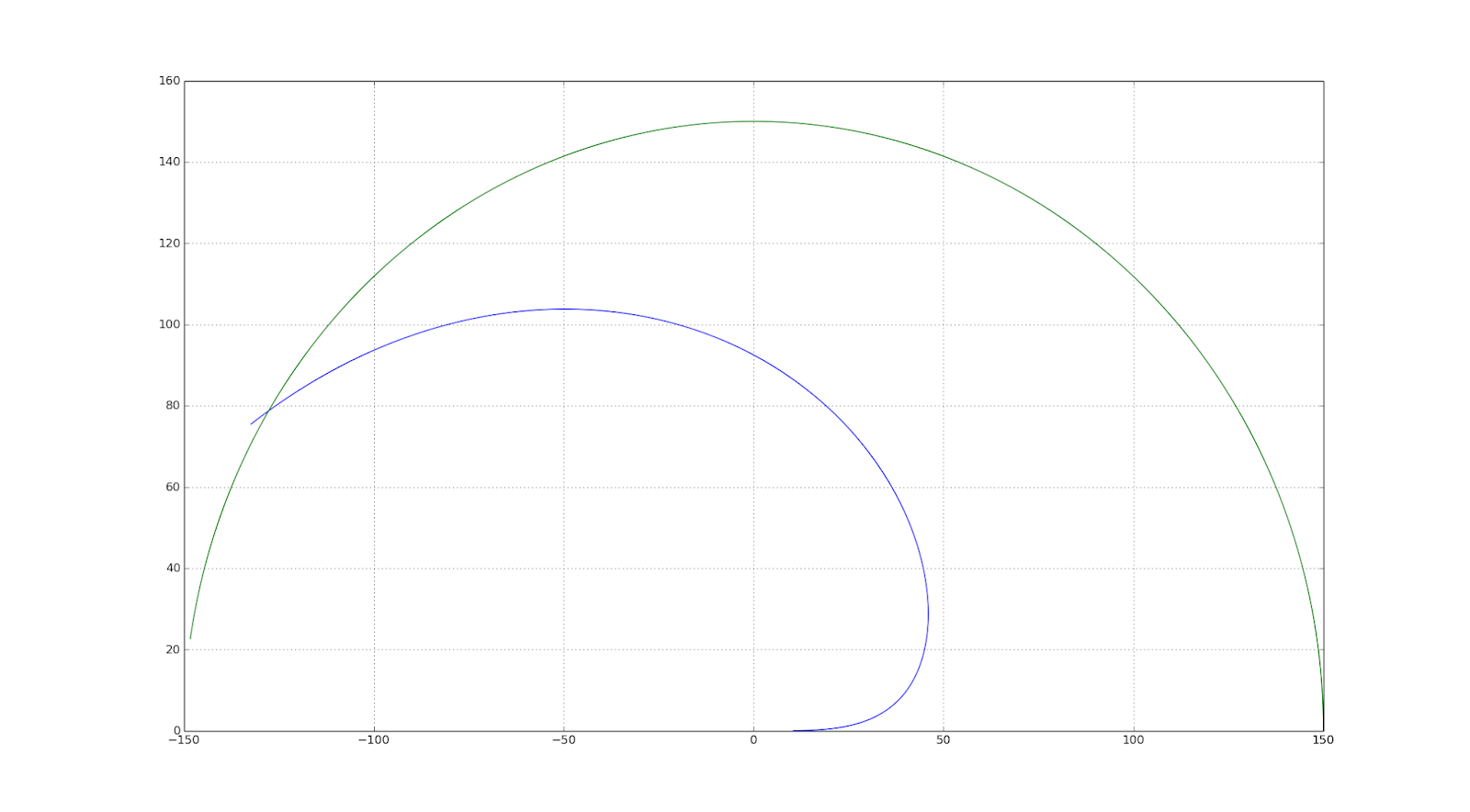
What if he just keeps going all the down? Remember, there is no force accelerating him outward. Velocities do not accumulate the way they do falling toward a planet; he is accelerated by the wind of the turning station, and that is always in a tangential direction. Here's the path he takes:
When he hits the "ground" he has a radial speed of about 7m/s and a tangential speed about 8 slower than the station is turning. So he hits about equivalently to jumping off the top of a truck doing 19 mph. He might break a leg, but would very likely live. If he hits flat, soft ground, and rolls, he has a decent chance of walking away.
Buildings and trees, on the other hand, are not his friends...
However, if his uniform had Rocky the Flying Squirrel webbing between arms and legs, he could very likely make a perfect two-point landing.

Wednesday, December 12, 2018

Is the heliopause shrinking?

Wait a minute, what's the heliopause?

There is a region of space, which may be thought of as the solar system, in which the effects of the Sun dominate the average conditions of the interstellar medium. Inside, there is the solar wind, a flux of charged particles emanating from the Sun; outside, there is a flux of galactic cosmic rays which is held at bay by the Sun's magnetic field. The heliopause is simply the name we give to the boundary.

Why might it be shrinking? Over the past several (11-year) solar cycles, it has been noted that the activity levels of the sun, measured by things like sunspots, have been waning.

That means that the Sun's magnetic field is getting weaker, and not shielding us from cosmic rays with the efficacy that it used to. And in fact, cosmic ray readings have been rising at observatories where such things are measured.

It occurred to me that we might have a direct measurement, however. The latest thing in the science news is that Voyager 2 has just crossed the heliopause, as detected by its measurements of its environment, notably the levels of cosmic rays. Voyager --> 2 <--.

Turns out that Voyager 1 crossed the heliopause some 6 years back. It was 121 AU from home. Voyager 2 just crossed the heliopause at 118 AU. So guess what, it does look like the heliopause is shrinking.

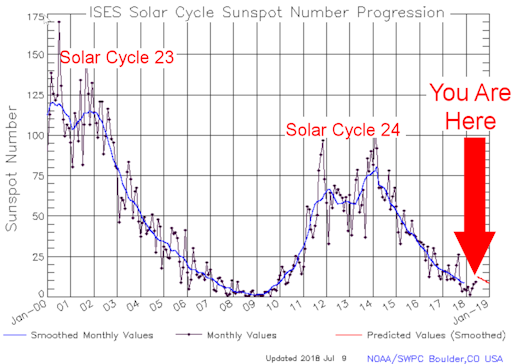
Maybe yes, maybe no. Turns out that having only two datapoints in a cyclic process, like the solar cycle, doesn't necessarily tell you a lot. We are at the bottom of a solar cycle, and Voyager 1 came out at the top of one:


So it definitely did shrink, but that may be part of a cycle.  On the other hand, it does seem to have reached interstellar space somewhat before scientists expected it to. So who knows.